
Guide
Leasing vs Buying a Car: The Full Cost Breakdown for 2026
Most people approach the lease-versus-buy decision the wrong way. They look at two monthly payment figures, pick the lower one, and call it done. But the monthly payment is probably the least useful number in this comparison.
It tells you what leaves your bank account every 30 days. It does not tell you what you own at the end, how much the interest added up to, what happens if you drive more than expected, or whether you will ever stop making car payments.
The stakes are higher right now because the numbers are bigger. The average new vehicle transaction price hit $49,191 in January 2026. The average new car payment is $748 per month. Interest rates have eased from their peaks but remain elevated, with good-credit buyers paying around 6.56% APR. A decision that was manageable to recover from five years ago now carries real financial weight over a multi-year horizon.
This guide walks through everything that actually matters in the comparison: how each option works at a mechanical level, what depreciation does to both scenarios, what the real cost difference looks like over 3 and 6 years, where each option can hurt you, and who each one actually suits. At the end, we look at a third model that sidesteps most of the trade-offs entirely for a specific type of driver.
Just a clear breakdown so you can make a decision you will not regret two years from now.
Key Takeaways
- ●Leasing lowers your monthly payment but keeps you paying for a vehicle's steepest depreciation years without building ownership.
- ●Buying costs more upfront but builds equity and eventually leads to a payment-free period, making it the stronger long-term financial choice for most drivers.
- ●The 3-year cost gap between leasing and buying is often smaller than expected. Over 6 years or more, buying typically wins because the loan ends while lease payments continue.
- ●Mileage limits and early termination fees are the biggest lease risks. Driving more than expected or changing vehicles mid-term can significantly increase costs.
- ●Luxury vehicles depreciate faster than most vehicles, which makes leasing attractive but also drives much of the lease payment itself.
- ●Luxury car subscriptions prioritize flexibility over cost savings, offering premium vehicle access, concierge service, and the ability to switch vehicles without long-term commitments.
- ●For pure cost efficiency, a 2 to 3-year-old certified pre-owned vehicle is often the best overall value, combining lower depreciation with long-term ownership benefits.
Where the Market Stands in 2026

Before comparing lease payments to loan payments, it helps to understand the conditions that make 2026 a particularly consequential year to get this decision right.
The average transaction price on a new vehicle hit $49,191 in January 2026. New car prices remain elevated despite some easing in the used-car market, where prices declined about 2% year over year.
Financing is still expensive. Buyers with good credit are paying around 6.56% APR on new vehicles, roughly double the rates common in 2020 and 2021. Nearly 20% of new car buyers now face monthly payments above $1,000, while fewer than 10% pay under $400.
Many buyers are stretching budgets to keep payments manageable. Seven-year auto loans have nearly tripled in popularity since 2015, often indicating affordability pressure.
At the same time, lease penetration has fallen to about 21% of new vehicle transactions. Changing EV incentives, residual values, and financing conditions have made leasing a more selective value proposition than it was in previous years.
How Leasing and Buying Actually Work
The mechanics of each option matter because the numbers that come out of them are built differently, and that difference changes what you are really paying for.
How a Car Lease Works
When you lease, you are not buying the car. You are paying for the portion of the vehicle's useful life that you consume over the lease term, which is specifically its depreciation. The lender calculates two figures: the capitalized cost (what the car is worth today) and the residual value (what they predict it will be worth at lease end).
Your monthly payment covers the difference between those numbers, plus a rent charge called the money factor, which is the lease equivalent of an interest rate, plus taxes.
A standard lease runs 36 months with annual mileage caps of 10,000 to 12,000 miles. Go over, and you pay a per-mile penalty at return. The car goes back to the dealer when the lease ends, or you can buy it at the residual value, though relatively few people actually do this.
How Buying Works
When you buy with a loan, you are financing the full purchase price minus your down payment. You pay principal and interest over a loan term that today averages 5 years and 9 months for new vehicles.
Once the loan is paid off, you own the asset outright. You can drive it payment-free, sell it, trade it, or modify it at any time. There are no mileage restrictions, no return conditions, and no approval required to change how you use it.
The core difference is not the monthly payment amount. It is what you are paying for. A lease buys you access to a vehicle for a defined period. A purchase buys you an asset that depreciates but that you own. That distinction matters enormously when you run the numbers over 5 or 6 years rather than 3.
The Depreciation Factor Nobody Talks About Enough
Depreciation is the largest cost of owning any vehicle, larger than fuel, larger than insurance, and larger than maintenance for most drivers over most holding periods. It is also the cost that never appears on a monthly statement, which is why it gets systematically underestimated.
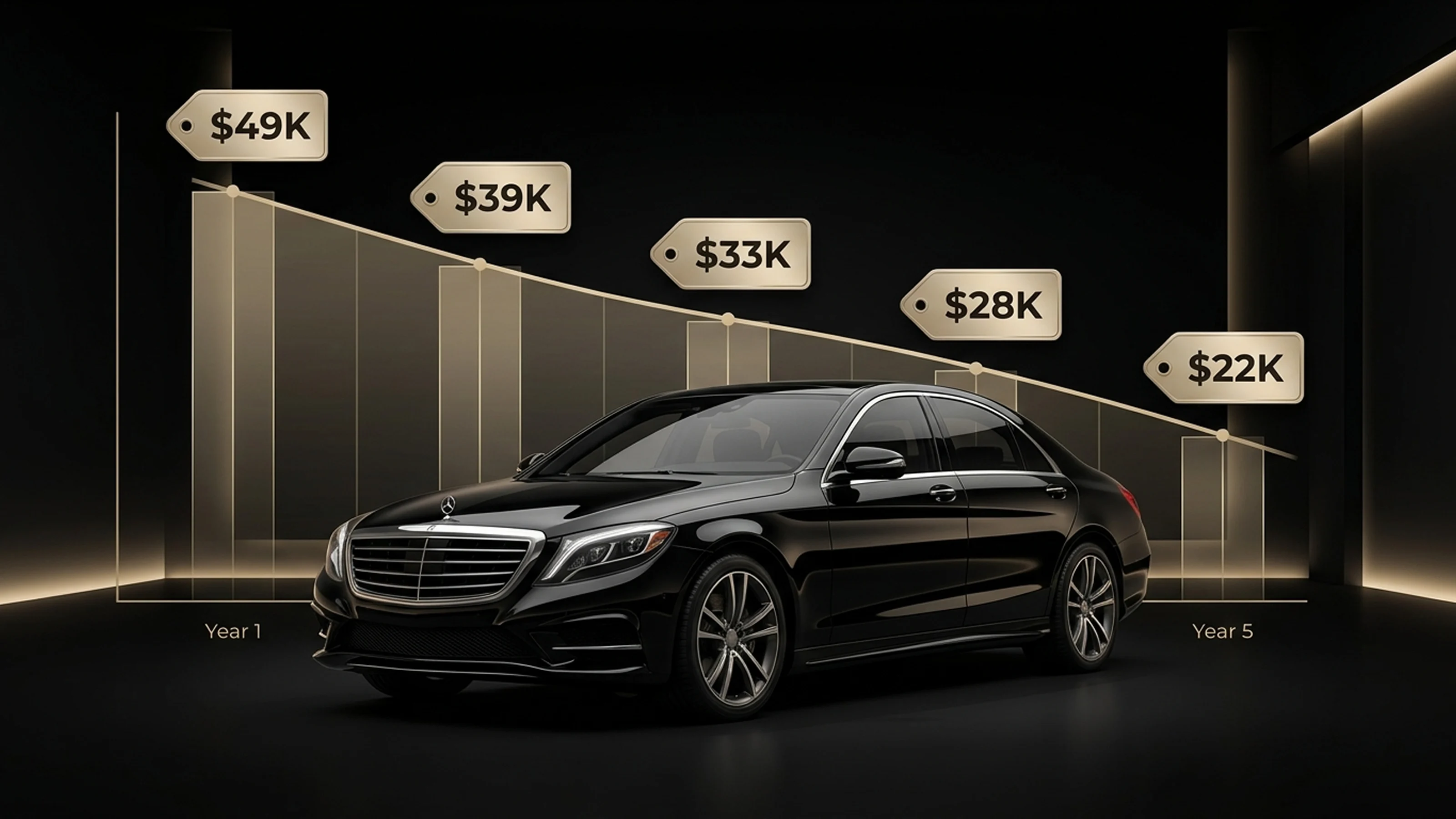
A new car loses approximately 20% of its value in the first year of ownership. By the end of year two, the average vehicle has shed about 30% of its original price. By year five, most vehicles retain only around 45% of their purchase value. On a $49,000 vehicle, that is roughly $27,000 gone in five years.
The rate of loss across five years, on a $49,000 vehicle
| Year | Approx. Value Lost | Cumulative Loss | Remaining Value |
|---|---|---|---|
| Year 1 | $9,800 (20%) | $9,800 | $39,200 |
| Year 2 | $5,880 (12%) | $15,680 | $33,320 |
| Year 3 | $4,600 (9%) | $20,280 | $28,720 |
| Year 4 | $3,500 (7%) | $23,780 | $25,220 |
| Year 5 | $2,940 (6%) | $26,720 | $22,280 |
Notice the curve. Depreciation is steepest in years one and two, then it slows significantly. This is a critical insight for the lease vs buy decision: a lease by design puts you in the vehicle during the steepest depreciation window. You pay for those big first-year and second-year drops through your monthly payment, then hand the car back to the dealer just as the depreciation curve starts to flatten out.
Buyers who hold a vehicle for 7 to 10 years absorb the heavy early losses but eventually get to drive through the flat, low-depreciation years, and eventually, with no payment at all. For luxury vehicles specifically, the depreciation picture can be even more dramatic.
Luxury sedans can lose 65 to 75% of their value over five years, which is partly why leasing a luxury car often looks so financially attractive on paper. The manufacturer is pricing that steep residual loss into your monthly payment, it is just that the loss is distributed, not erased.
Side-by-Side Cost Breakdown of Leasing vs Buying a Car
The following scenarios compare leasing vs buying on a $55,000 luxury sedan, which represents the mid-range of the luxury vehicle market and a realistic target for buyers considering a MotorEnvy-level vehicle. These are illustrative estimates based on current market rates.
Scenario A: 36-Month Lease
| Capitalized Cost | $55,000 |
| Residual Value (52% of MSRP) | $28,600 |
| Depreciation Covered | $26,400 |
| Rent Charge (Money Factor equiv. ~7% APR) | $6,270 |
| Drive-Off Costs (first month + fees) | $2,500 |
| Estimated Monthly Payment | $910/month |
| Total 3-Year Out-of-Pocket | $35,260 |
Scenario B: 60-Month Purchase Loan
| Purchase Price | $55,000 |
| Down Payment (10%) | $5,500 |
| Loan Amount | $49,500 |
| APR | 6.56% |
| Monthly Payment | $967/month |
| Total Paid at 3 Years | $40,312 (still paying) |
| Remaining Loan Balance at Year 3 | $22,500 |
| Estimated Vehicle Value at Year 3 | $34,000 (equity: ~$11,500) |
At the 3-year mark, leasing costs less out-of-pocket: $35,260 versus $40,312. However, the buyer has approximately $11,500 in equity. The lessee has no asset to show for their payments.
Extend the view to year 6. The buyer finishes paying the loan at month 60 and drives payment-free through years 6 and beyond, holding a vehicle worth around $18,000. The lessee has entered a second lease, spending another $32,760 or more over 36 months. By year 6, the lessee has spent more in total payments and owns nothing. The buyer, despite higher monthly costs, has spent less in total and holds an asset.
Leasing vs Buying a Car: Pros and Cons
| Factor | Leasing | Buying |
|---|---|---|
| Monthly Payment | Lower (lease wins short term) | Higher |
| Down Payment | Minimal (first month + fees) | Typically 10 to 20% recommended |
| 3-Year Total Cost | Lower, but no equity built | Higher, but ~$11,500 equity |
| 6-Year Total Cost | Continuous payments, no asset | Payment-free after loan paid; owned asset (buying wins) |
| Mileage Limit | 10,000 to 12,000 miles/year; penalties beyond | No limit (buying wins) |
| Maintenance in Warranty | Covered; predictable costs (lease wins) | Covered early; costs rise after warranty |
| Customization | Not permitted | Full freedom (buying wins) |
| Early Exit | Expensive; penalties can be significant | Sell or trade anytime (buying wins) |
| Access to New Models | Every 2 to 3 years (lease wins) | Only when you choose to sell or trade |
Flexibility: What You Give Up With Each Option
Cost is only one dimension of this decision. Flexibility is the other, and it is where the hidden costs of leasing tend to surface most painfully.
The Lease's Flexibility Ceiling
A lease feels flexible at the start: lower payments, a defined end date, and the promise of something new in three years. But inside those 36 months, you are operating within a fairly rigid set of rules. The mileage cap is the most visible. If your work situation changes, you relocate, or you simply have a year where you drive more than expected, overage charges add up.
Getting out of a lease early is also genuinely costly. Most contracts require you to pay the remaining monthly payments, a termination fee, and sometimes the difference between your car's current market value and its residual, a gap that can run several thousand dollars. A lease is a 36-month obligation that is expensive to exit. If you are not certain your life circumstances will stay stable over that period, that inflexibility deserves serious weight.
The Buyer's Flexibility Advantage
Buying is rigid on the entry side, requiring more money upfront and a higher monthly payment. But once you own the vehicle, the flexibility is significant. You can sell it next month if your situation changes. You can refinance if rates drop. You can drive as many miles as you want. You can trade it in on short notice without negotiating your way out of a complex contract.
One specific warning for anyone leaning toward leasing: be cautious about putting a large down payment on a lease. If the vehicle is totaled or stolen early in the term, gap insurance covers the outstanding balance owed to the lender.
But your down payment is not covered. It disappears. Keeping drive-off costs minimal on a lease, with most of the cost flowing through monthly payments, is generally the more financially sensible structure.
The Driver Profile That Actually Benefits From Leasing
Leasing is not a bad deal for the wrong person. It is a genuinely good deal for the right one. Here is what that profile looks like.
Lease If This Describes You
- ●You drive under 12,000 miles a year consistently. Mileage caps are a non-issue, and you will never pay an overage fee at return.
- ●You want lower monthly payments without a large down payment. Leasing requires less upfront and keeps payments below what a purchase loan on the same vehicle would cost.
- ●You like driving a new model every 2 to 3 years. A lease is built exactly for this. Every cycle ends with a new vehicle and no trade-in negotiation.
- ●You want to stay within a manufacturer warranty for the full term. Maintenance costs stay predictable and repairs are generally covered during the standard lease window.
- ●You are self-employed or a business owner. Lease payments are often deductible as a business expense, which changes the net cost calculation meaningfully.
Be Cautious About Leasing If...
- ●Your commute or life circumstances could change. A mid-lease exit is expensive. If there is meaningful uncertainty about your next 36 months, that matters.
- ●You regularly drive over 12,000 miles a year. Calculate this honestly before signing. Most people underestimate their annual mileage.
- ●You tend to keep vehicles longer than 4 years. If you have a history of holding on to cars, a purchase will almost certainly be more cost-efficient for you.
Who Should Buy a Car?
Buying usually makes the most financial sense if you plan to keep the vehicle for six years or more. Once the loan is paid off, you can continue driving without monthly payments, while leasing requires you to keep renewing contracts.
Ownership is also a better fit for high-mileage drivers. If you drive more than 15,000 miles per year, buying eliminates mileage limits and overage fees that can make leasing expensive.
Buying could also be the right choice if you want to build equity and have full control over your vehicle. Owners can modify, sell, trade in, or use their vehicles however they choose. Plus, when the vehicle is paid off, it still retains resale value that can be recovered later.
Vehicles with strong resale values, such as the Toyota Tacoma or Porsche 911, can make ownership even more attractive because they depreciate more slowly than average.
When to Be Cautious About Buying
Buying may be less attractive if you're financing a vehicle that depreciates quickly, such as some luxury sedans or EVs. In these cases, the loss in value can be substantial.
You should also think carefully before taking out a seven-year loan just to lower the monthly payment. Longer loans increase interest costs and can leave you making payments on an aging vehicle that may soon need repairs.
Finally, if a certified pre-owned vehicle is available, it may offer better value than buying new since the first owner has already absorbed the steepest depreciation.
What Is Usually the Cheapest Option Overall?
If your primary goal is minimizing total vehicle costs, the answer is surprisingly simple: neither leasing nor buying a brand-new vehicle is usually the cheapest option.
In most cases, a 2 to 3-year-old certified pre-owned (CPO) vehicle delivers the best overall value. The first owner absorbs the steepest depreciation, often 20% in the first year alone and around 30% by the end of year two. By purchasing after that initial drop, you avoid the most expensive part of the vehicle's value loss while still getting a relatively modern vehicle, warranty coverage, and updated technology.
For example, a vehicle purchased for $50,000 may be worth only $35,000 to $40,000 after a few years. A lease customer effectively pays for much of that depreciation through monthly payments, while a CPO buyer acquires the vehicle after those losses have already occurred.
That said, the cheapest option is not always the best option.
Many drivers are willing to spend more for benefits that traditional ownership does not provide, such as driving newer vehicles, avoiding long-term depreciation exposure, staying within warranty coverage, or having the flexibility to change vehicles as their needs evolve.
This is where the decision shifts from pure cost optimization to lifestyle fit. Buying a certified pre-owned vehicle may win on total dollars spent, but leasing, buying new, and subscription models can provide advantages that matter more depending on how you drive and what you value.
The real question is not simply which option is cheapest. It is which option delivers the right balance of cost, convenience, ownership, and flexibility for your situation.
The Third Option: Luxury Car Subscription
Both leasing and buying were designed for a market where drivers settled on one vehicle and committed to it for 2 to 7 years. That model still works for a lot of people. But a growing segment of drivers, particularly in the luxury and exotic space, does not want to commit.
They want the vehicle that fits their life this season, the freedom to change when something better comes along, and none of the paperwork, depreciation exposure, or mileage anxiety that comes with traditional vehicle access. This is where a membership-based model changes the math entirely.
How MotorEnvy Works
MotorEnvy operates as a luxury car subscription, not a dealership, not a traditional lease company. You pay a monthly membership for full access to a curated inventory of premium and exotic vehicles, with a dedicated concierge who handles sourcing, delivery, maintenance, insurance coordination, and vehicle transitions.
Plans run from 3 months to 12 months, with custom terms available for drivers who need something different. When your needs change, you swap. When you want something new, you swap. There is no 36-month contract holding you in a car that no longer fits your life.
How Subscription Compares to Traditional Leasing
On a straight monthly cost comparison, a luxury car subscription carries a higher price per month than a standard lease on the same vehicle. That is the honest answer, and it is worth saying clearly. The subscription model does not win on unit economics for a driver who wants to optimize monthly outlay.
Where the comparison shifts is in what is included. A standard lease gives you a car and a contract. A subscription wraps maintenance, insurance coordination, delivery logistics, and a genuine exit option: all under one monthly number managed by a single point of contact. There is no balance sheet exposure to depreciation, no gap insurance to purchase, no overage calculation at return.
For the executive who needs a different vehicle in Miami for Q1 and something different in New York for Q2, a lease structure makes no sense. For the enthusiast who wants to drive a Lamborghini Urus for six months and then transition to a Porsche 911, the traditional purchase route requires either two transactions or ownership of something they may not want long-term. The subscription model was built for exactly these profiles.
MotorEnvy is not trying to compete with the economics of a 7-year loan on a Toyota. It is an alternative to the traditional lease for drivers who have already decided they want something exceptional, and who want the flexibility to change their mind without penalty.
What Subscription Is Not
A luxury car subscription is not right for everyone, and it would be misleading to suggest otherwise. If you drive a commuter vehicle, plan to keep it for a decade, and want the lowest total cost over time, buying a well-reviewed used car is still the most financially conservative path. The subscription model earns its premium for drivers who value flexibility and access over ownership, and who would rather hand the logistics overhead to someone else.
Final Verdict
After walking through all of this, the answer to "should I lease or buy?" is genuinely situational, but the framework to reach your own answer is not complicated.
Lease if: you drive under 12,000 miles a year, want lower monthly payments, like upgrading every 2 to 3 years, stay within warranty periods, and your life circumstances are stable enough that you will not need an early exit.
Buy if: you drive a lot, plan to hold the vehicle for six or more years, want to build equity, need full freedom over how you use the vehicle, or want to eventually reach a payment-free period. Buying used, particularly 2 to 3 years old, is often the most cost-efficient path of all when depreciation is accounted for properly.
Consider a subscription if: you want a luxury or exotic vehicle, flexibility is your top priority, you change vehicles more frequently than a standard lease allows, or you want the full concierge experience without the administrative overhead of traditional vehicle ownership.
The one thing that consistently leads people to regret their decision is comparing monthly payments in isolation. A $150/month difference between a lease and a loan means very little without knowing what you own at the end, how much the mileage overage cost you, or what the interest charges totaled up to. Run the full numbers. Think in terms of 3 years, 5 years, and what you will wish you had done. The decision looks different at every time horizon.
If you are in the market for a luxury vehicle and want to explore what a membership-based model looks like in practice, MotorEnvy's concierge team can walk you through available inventory and subscription plans across their service areas in New York, New Jersey, Florida, California, Colorado, Connecticut, and Pennsylvania.